
Members of Parliament and Legislative Assemblies can recommend local area development works that create lasting public assets and improve essential services. Healthcare access remains one of the hardest gaps to close in remote and economically weaker areas, and it is a recognised use of these funds.
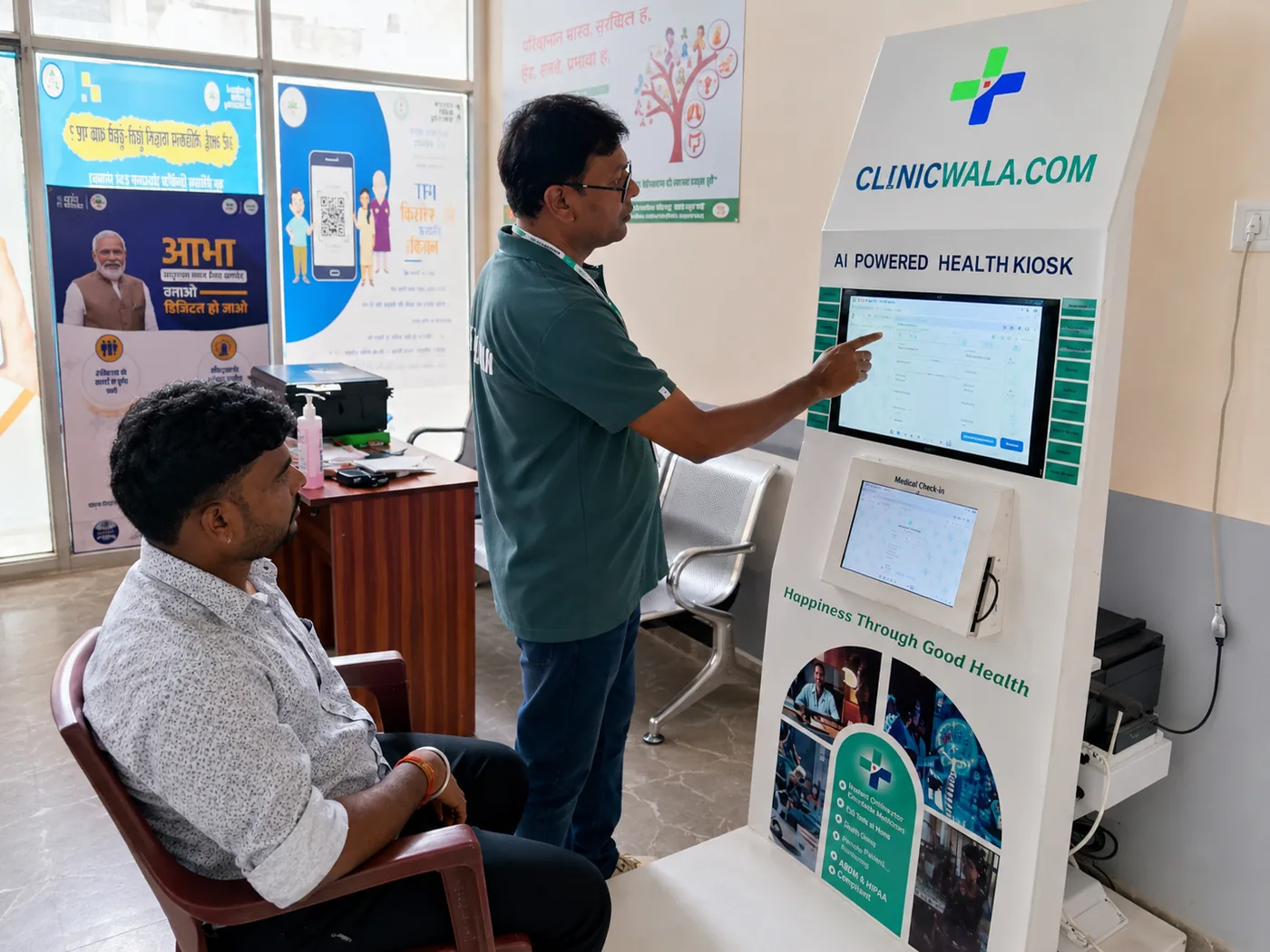
ClinicWala’s programme units — fixed health kiosks, portable Doctor-in-a-Box setups, and clinic-on-wheels vehicles — are built for exactly this: primary care, diagnostics and telemedicine delivered at the doorstep, with digital health records that let the administration see what the asset actually delivers.
What these funds can create
Each is a durable asset with published running costs, staffed and operated by ClinicWala.
A health kiosk for the constituency
A fixed screening and teleconsultation point covering vitals, ECG, spirometry, haemoglobin and more, run by trained local staff.
A clinic on wheels
A mobile unit that takes the same diagnostics and doctor access village to village on a published route.
Recurring health camps
Screening camps with documented findings, referrals and follow-up rather than one-day events.
Digital health records
Every beneficiary keeps a record, ABHA-linkable, so the programme’s reach and results are measurable, not anecdotal.
Referral into government schemes
Patients needing hospitalisation are guided to hospitals covered by state and central government healthcare schemes.
Sadar Hospital, Dhanbad — a working example
This is not a proposal; it is a programme in progress. At Sadar Hospital, Dhanbad — a Government of Jharkhand facility — a ClinicWala AI-powered health kiosk runs a comprehensive health screening programme for the community: digital registration, vital-parameter monitoring, advanced diagnostic investigations and preventive health services, focused on early detection of non-communicable diseases, cardiovascular risk, respiratory illness, anaemia and neuropathy.
A digital health record is generated and updated for every beneficiary, supporting continuity of care, specialist referrals where required and long-term follow-up. The programme reports weekly, so the administration sees exactly what the asset delivers — prevent, detect, protect.
The fourth week, in numbers
From the programme’s fourth-week progress report (reporting period 03–08 August 2026). One kiosk, six days:
- Beneficiaries screened
- 232 (137 male, 95 female)
- ABHA IDs linked
- 108 — 46.6% of beneficiaries
- Body-composition analysis
- 226 screened — 97.4% coverage
- Blood pressure
- 211 screened — 90.9% coverage
- Oxygen saturation (SpO₂)
- 196 screened — 84.5% coverage
- ECG / cardiogram
- 182 examinations — 74.3% coverage
- Neuropathy screening
- 161 screenings
- Mental-health assessment
- 125 assessments
- Haemoglobin (anaemia)
- 112 tests
- Spirometry (lung function)
- 92 tests
- Vision & hearing
- 89 vision and 16 hearing screenings
- Uric acid & pathology
- 47 uric-acid tests and 11 comprehensive pathology profiles
What those numbers are
Figures are from the programme’s own weekly progress report for that reporting period — a snapshot, not a cumulative total. They are published to show what one kiosk in one government facility delivers in a week, measured rather than promised.
The units that do the work
Bring a programme like this to your district
Public representatives and district authorities: tell us the facility, the population and the goal, and we will bring the unit configurations, costings and reporting formats for MPLAD, MLALAD and allied funds.
Talk to us